


Jump to:
- About This Recipe
- Cheese Curds are a classic...but what are they?
- Best When Fresh
- Why do Cheese Curds Squeak?
- Ingredients Notes
- How to Make Fried Cheese Curds in Beer Batter
- Should You Freeze Cheese Curds Before Frying?
- Different Ways to Prepare Fried Cheese Curds
- How Do You Store Fried Cheese Curds?
- You Might Enjoy
- Recipe
About This Recipe
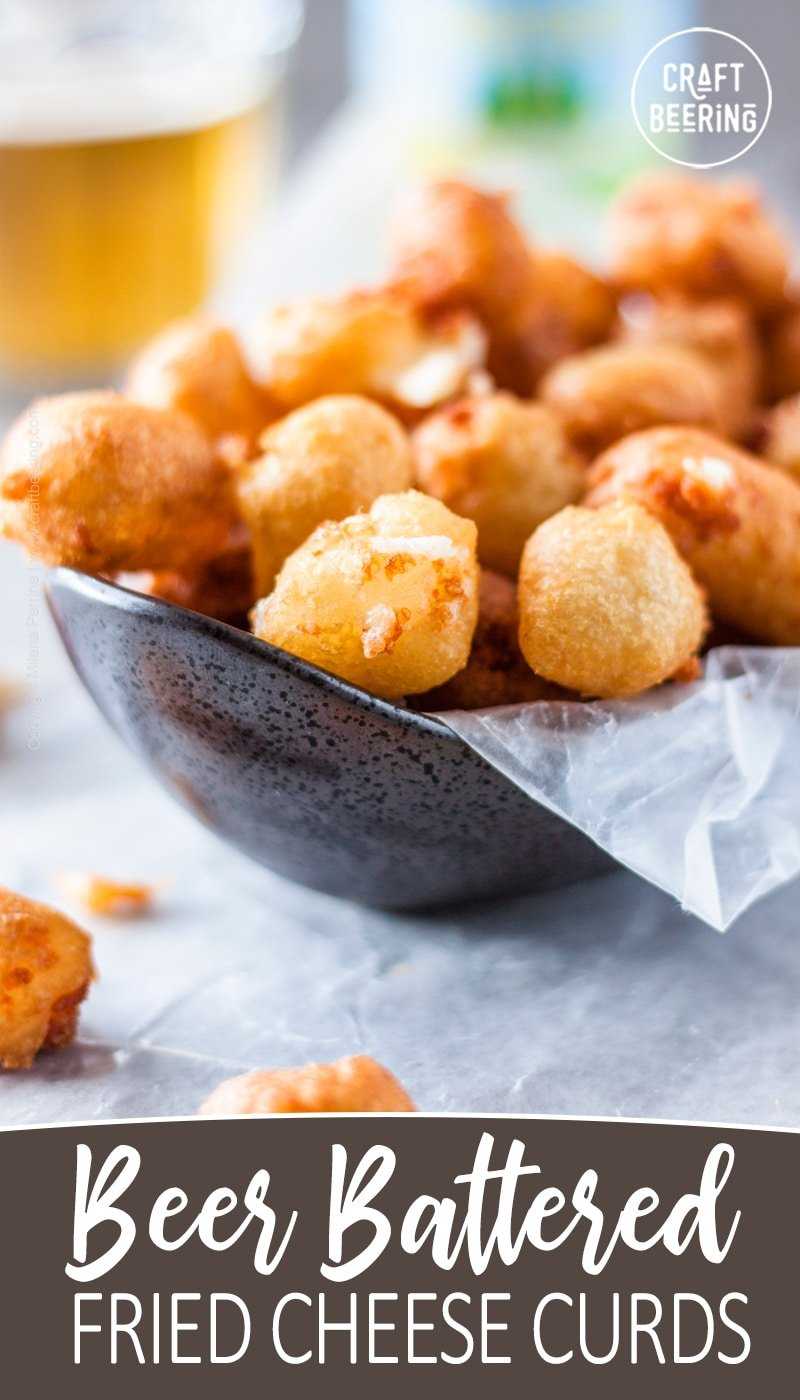
Eaten fresh, as a classic topping in poutine or deep fried, cheese curds have many raving fans, especially among the ranks of beer lovers. When beer battered and fried they are truly an iconic food item in America and a welcome member of any beer garden menu.
This recipe takes a very basic, classic approach to making them and uses the bare minimum of needed ingredients. Should you want to spice things up a little bit consider the section about other ways to prepare fried cheese curds towards the bottom of this post.
Cheese Curds are a classic...but what are they?
Cheese curds are coagulated dairy chunks which are the product of the first stage of cheese making. Think of them as baby cheese.
Cheese curds are made by adding rennet and mesophilic culture cheese starter blends to warm milk. The type of bacteria in the starter culture determines the type of cheese curd (cheddar is the most common). After the milk separates the whey is drained from the curds, the curds are shaped into a single mass and cut into slabs and then through a series of cheddaring steps any residual whey is removed and the fresh cheese curds are cut.
Best When Fresh
Cheese curds have a landmark springy, rubbery texture and are best eaten fresh. If you ever had cheese curds made the same day you know how much better the texture is versus those that have been sitting refrigerated for a few days.
They are often sold already flavored besides the salt added at the end of the making process. Popular flavors are Cajun, BBQ, Onion & Garlic, Dill, Ranch etc.
We used white cheddar cheese curds from a local creamery which we bought from the local cheese section of our grocery store. Relatively fresh and perfectly fine for making fried cheese curds. They were quite squeaky when we tasted them plain prior to frying.
Why do Cheese Curds Squeak?
Squeaking is a signature attribute of fresh cheese curds. Here is why.
There are long protein strands in them which are very elastic and upon contact with your teeth the rubbing of those strands against the enamel produces a squeaky sound. The fresher the curd the more pronounced the squeak.
After a day the curds begin to lose their squeak as the bacteria used to make them continue to work and increase their acidity content and break down the long proteins into smaller and less elastic fragments.
Ingredients Notes
The fresher the cheese curds the better. If you have cake flour (contains a smaller percentage of gluten forming proteins) use it instead of all purpose flour. Use a neutral frying oil such as vegetable or sunflower. Do not reuse oil you have fried other foods in before - the flavors of the curds and their batter are delicate and they can easily be altered in an unpleasant way if the curds pick up strong flavors imparted by the food from a previous frying session.

How to Make Fried Cheese Curds in Beer Batter
The step-by-step instructions are listed and illustrated in the recipe card below. Please consider these few tips in order to ensure a smooth workflow and enjoyable results.
1. Make sure the curds are very cold, especially if it is summer when it seems that as soon as you take them out of the fridge they reach room temperature and are then likely to be melted by the cooking oil and seep out of the casings.
2. Heat the oil exactly to 350 F and not any higher. Once the first batch of curds goes in they will cook very fast. If you only fry 4 to 6 at a time the temperature will not drop significantly and will be easy to maintain as you go to the next batch.
3. Mix the batter while the oil is heating up and not earlier. Use very cold beer. Doing this will ensure that gluten does not have a chance to form and the fried casings of the curds will be crispier.
Should You Freeze Cheese Curds Before Frying?
You do not need to actually freeze the curds but you can place them in the freezer for a little while just before you fry them simply to make sure they are very cold and firm.
Different Ways to Prepare Fried Cheese Curds
You can prepare fried cheese curds in a number of ways so feel free to make alterations to our basic recipe below. For this post we simply whipped up a basic batter with a beaten egg and beer and selected a pale ale with a good balance of malts and herbal hops.
It is definitely fun to experiment with differently flavored curds and methods of making them. You can truly identify your favorite kind of fried cheese curds. Whenever we can get our hands onto dill flavored ones we add garlic powder to the batter - the result is impressive.
Here are a few other suggestions to prepare fried cheese curds:
- breaded fried cheese curds - simply toss in flour, dip in egg wash and then roll in bread crumbs
- soda water battered fried cheese curds - replace the beer in our recipe with soda water and add a bit of sugar to compensate for the loss of malty sweetness
- buttermilk battered fried cheese curds - use buttermilk in lieu of the beer in the recipe below
- spice battered fried cheese curds - follow the recipe below but add your favorite spice to the batter - we particularly like adding smoked paprika
How Do You Store Fried Cheese Curds?
It is best to not have to store fried cheese curds at all. Try to prepare just enough to enjoy as soon as they are ready. Once cooled down the crispy outer casing and the soft inner texture are irrevocably lost and with them the gustatory pleasure of eating the curds.
Recipe

Fried Cheese Curds in Beer Batter
Ingredients
- 2 quarts cooking oil for frying
- 1 to 2 lbs of fresh cheese curds you will have leftover batter if you use 1 lb and enough for 2 lbs
- 1 egg beaten
- ¾ cup flour* + a bit more to toss cheese curds prior to dipping them in the batter
- 1 teaspoon baking soda
- 1 teaspoon salt
- 1 cup chilled beer 8 oz or just a bit more, up to 10 oz**
Instructions
- Place the cheese curds in the freezer for about half an hour just prior to frying them (optional step, but highly recommended, see relevant post section above).
- Heat the oil in a heavy bottomed pot to 350 F.
- As the oil is heating fill a small bowl with flour (depending on how many curds you have about ½ cup). Toss the curds in flour, shake of excess and set them aside.

- In another bowl make the batter. Mix flour, salt and baking soda. Add the beer to the beaten egg and mix. Add this mixture to the flour and mix with a fork until a thinnish batter forms.
- As the oil reaches 350 F begin frying. Working 4 to 6 flour coated curds at a time dip them in the batter and fry until they turn golden. Remove with a slotted spoon and allow them to drain over a wire rack*** or paper towel covered plate.
- Enjoy immediately.


Raschell | MissHomemade.com
I stopped scrolling immediately when I saw these babies. Looks awesome. Here in Wisconsin my first love is fresh, squeaky curds and my second when they are fried. Great website and so informative. Looking forward to more.
Jas - All that's Jas
Those look dangerously delicious. They deserved the feature! So easy to pop them in the mouth and not know when to stop, lol. YUM. Pinned.
Christina
I'm originally from the midwest where beer and cheese are a food group. The BEST food group in my opinion. Nothing is more satisfying then sipping a cold brewski and munching on some fried cheese. I'm excited to see your beer garden menu! Your website brings me so much happiness. Whenever I'm stressed I just come back here and gaze upon your stunning photography of tasty morsels and beer and I instantly feel beer. BETTER! I mean better 🙂
CraftBeering
LOL! Very well stated, beer and cheese are a food group!
Dawn - Girl Heart Food
Girl, stop whatever you are doing and send me some of these, ok?!?! Seriously, though, this is right up my alley. We have cheese curds on poutine every once in a while for a lil' treat, but beer battered? Now, that's taking it to another level. I would have a hard time sharing these. Side note---> can you imagine THESE on poutine?! Mind blown. Pinned and can't wait to try 🙂
CraftBeering
Lol:) All I can say is that the first time I had real poutine in Canada I was mind blown. Can hardly imagine a more indulgent, cozy thing to eat in winter. It has a special place in my heart and cheese curds are so essential to the experience...We need to make some poutine soon! Have a great week!
Nicoletta @sugarlovespices
I love almost anything deep-fried, and these cheese curds are looking so appealing! I don't think I've ever had them, but I know I would like them a lot! With a cold beer, they would be just perfect and I'm worried about how many I could eat! 🙂 Cannot wait for your 'beer garden' section!!
CraftBeering
Thank you, Nicoletta! They are so good:)
annie@ciaochowbambina
There is nothing not to love about these bites! Absolutely nothing! Pinned!
CraftBeering
Cheers, Annie!
Kelsie | the itsy-bitsy kitchen
I let out an audible sigh when I saw the name of this post :). Cheese curds hold a special place in my heart because of a road trip to Tillimook with my aunt when I was little. I'll have to send this recipe to her! I think the only way to improve upon a cheese curd is to fry it!
CraftBeering
Thank you, Kelsie! I bet the cheese curds you had were super fresh!
Helen at the Lazy Gastronome
We get cheese curds every time we visit Tillamook (cheese factory). This recipe will be tried next time - pinning. Thanks for sharing at the What's for Dinner party!
CraftBeering
Thank you so much Helen for stopping by!